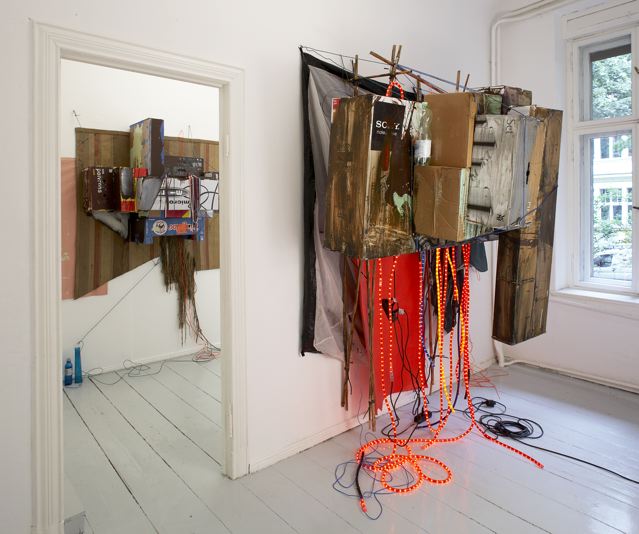
Knut Eckstein builds models. However, it is never really clear what these models are. There are aesthetic leanings: towards facades, gaps between buildings, boundaries of all kinds, as well as exterior architectural situations. In the end, they seem to quote all that the flaneur notices if he pays attention during his travels in this world and is interested in the ‘rear landscapes’ of our society. Eckstein’s models are utopias of the everyday; they come from the everyday and disappear into it again. They appear like fictional notations, constructed from cardboard, various adhesive tapes, wooden battens, neon lamps, the usual industrial materials. It always sounds so easy, but Ecksteins’s works offer projection screens; above all, because they programmatically withdraw from reality and simultaneously start from an actual, existing moment. This makes them fundamentally ambiguous in their attitude, for they remind one of something that they never really are. They are in a permanent condition of possibility. Can one explain it that way? Perhaps, for if we speak of a condition, we do not mean a selective but an atmospheric space, a space in which ambivalent perceptions have a place. In this terrain the optional qualities of KE’s works play a major role; and because this is so, or at least appears to be so, everything remains in limbo. (...)
Dorothea Strauss